
Woburn Previous Residents Sources
The best source changes with the era. For recent Woburn address history, start with the assessor and deed trail. For earlier households, use the address sequence in a directory, dated poll material, and the closest census. Maps and permits explain what stood on the land and when it changed, but they do not list residents. The table puts each record in its proper time range and access channel so a missing online result does not stop the search.
| Source | Years it covers | Where held | What it shows |
|---|---|---|---|
| Woburn assessor and WebGIS | Current fiscal-year parcel data; city tax history lists 2014 through 2026 | VGSI portal, WebGIS, and Assessing Department | Current owner, parcel, address, value, and physical description |
| Middlesex South deed index | Current online records; scanned grantor indices 1896 through 1973 | MassLandRecords, Registry counter, and historic books or plans | Transfers, mortgages, liens, plans, legal descriptions, and record numbers |
| Digitized Woburn directories | Listed runs from 1868 through 1937, with incomplete ongoing indexing | Historical Commission visual database and local library | Occupants, address, occupation, and possible owner or renter marks |
| State Library directories | Scattered early runs plus 1959, 1960, 1966, and 1978 through 1980 | State Library of Massachusetts and local collections | Directory snapshots and house or address material where available |
| Poll lists and census | Poll materials from the 1880s with gaps; census microfilm 1790 through 1920, public federal schedules through 1950 | Glennon Archives, City Clerk, State Library, and NARA channels | Dated people or household evidence, street context, and occupations |
| Sanborn maps and newspapers | Sanborn maps 1867 through 1971; newspaper indexes 1844 through 2014 by title | Glennon Archives | Building context, street labels, deaths, moves, notices, and events |
Start with the narrowest dated record that matches the address. A current owner record is useful for the deed chain; an address directory is stronger for a past occupant. Keep both when they point to different people.
Woburn Past Resident Parcel Start
Current parcel data gives the stable key for a backward search. The Woburn Assessors database supports location or address, owner, and parcel-identification searches. Copy the situs address, current owner, mailing address if displayed, parcel ID, and any legal-description or book-and-page reference. The city’s January 1 owner-of-record rule can leave an early tax bill showing a prior owner after a new deed is recorded, so treat the fiscal date as part of the result.
Then open Woburn WebGIS with the same address. It can search by name, address, or map/block/lot and helps match the parcel to its surrounding streets and older map references. Map lines and measurements are approximate. Use the parcel ID, lot, plan, and deed legal description rather than the screen line alone when an older address does not line up cleanly.
Woburn Previous Residents Deed Chain
A deed chain traces ownership, not every household. It is still the most dependable backbone for tracing prior occupants because it moves from today’s parcel to the earlier seller and then to that seller’s prior purchase. Middlesex South uses different identifiers for recorded land and registered land. Recorded land usually relies on book and page, while registered land uses Land Court document and certificate numbers. If an address search fails, the older key may be the legal description, a plan, or book and page.
- Use the assessor card to note the current owner, situs, parcel key, and legal-description clues.
- Search Massachusetts Land Records for Middlesex South with Woburn as the town. Try Property Search, then the owner name, address variations, and book or page if needed.
- Open the latest purchase deed. Record the grantee, grantor, recorded date, book and page or document number, legal description, and plan references.
- Search the seller as a prior grantee, using the same parcel or legal description to find the earlier purchase. Repeat the transfer loop one deed at a time.
- When an index is unindexed or the address changes, use book/page, a plan, the lot, or the Registry counter and historic books. Do not substitute a similar street number for the legal parcel.
The Middlesex South Registry of Deeds access page shown here is the official path for current records, counter help, and copy rules.
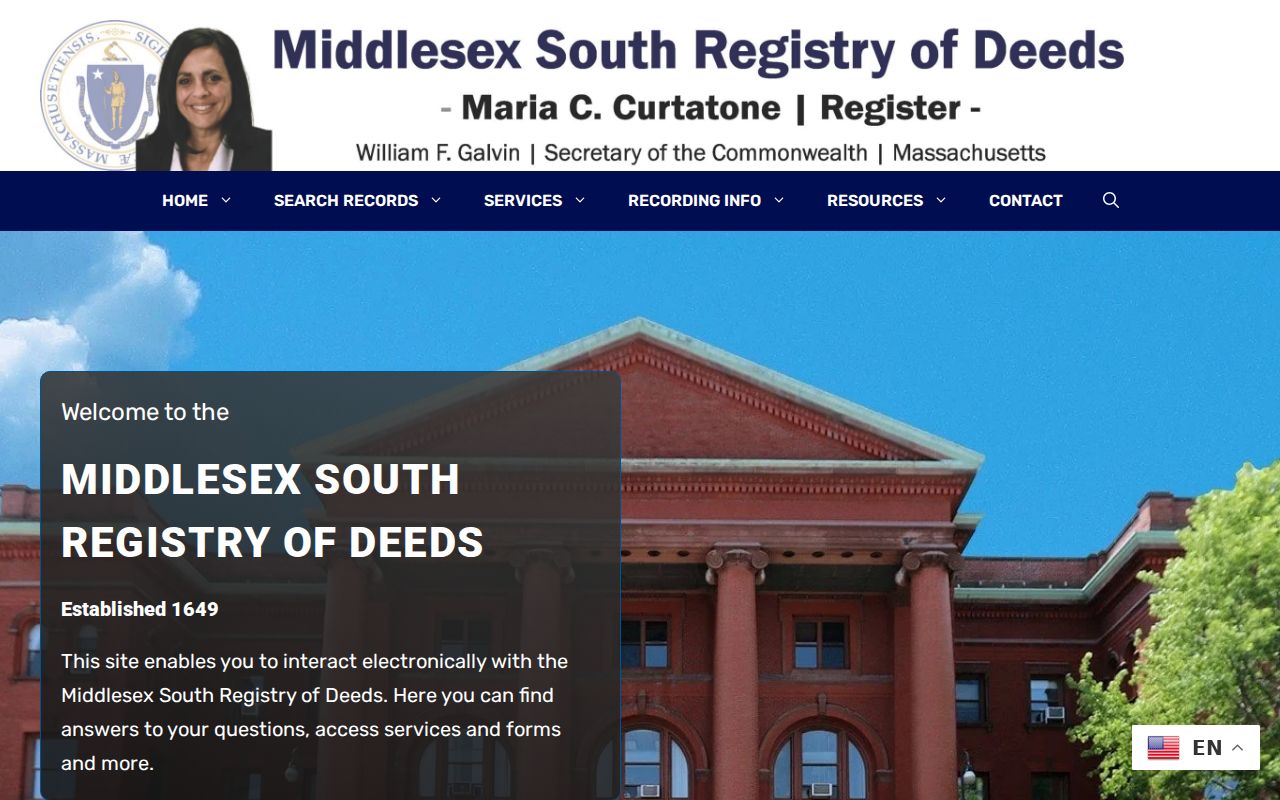
Online viewing, printing, and downloading are free at the Registry’s current portal. Certified documents follow the Registry’s request process and fees, so save the free image and record number before deciding whether certification is necessary.
- Grantor and grantee
- The grantor gives or sells an interest in property; the grantee receives it.
- Chain of title
- The linked sequence of recorded transfers for the same property or legal parcel.
- Legal description
- The deed’s lot, plan, or boundary description, which can stay useful when a street number changes.
- Registered land
- Land with a Land Court title system, commonly searched with certificate or document numbers rather than only book and page.
Woburn Previous Residents Index Bridge
The online historical bridge is stronger than it once was. On October 21, 2025, Middlesex South announced free scanned grantor-index files for 1896 through 1973. The files include a directory for 1896 through 1950, individual volumes for 1951 through 1955, and period folders through 1973. Older index pages may show only the first name on a page, so inspect nearby alphabetic entries and copy the book/page details before moving to the deed image.
The Registry’s grantor-index announcement is the source for the historical file path pictured below. This release is a useful comparison with a search box alone: a scanned index can lead to a deed when a modern property search has no address hit.
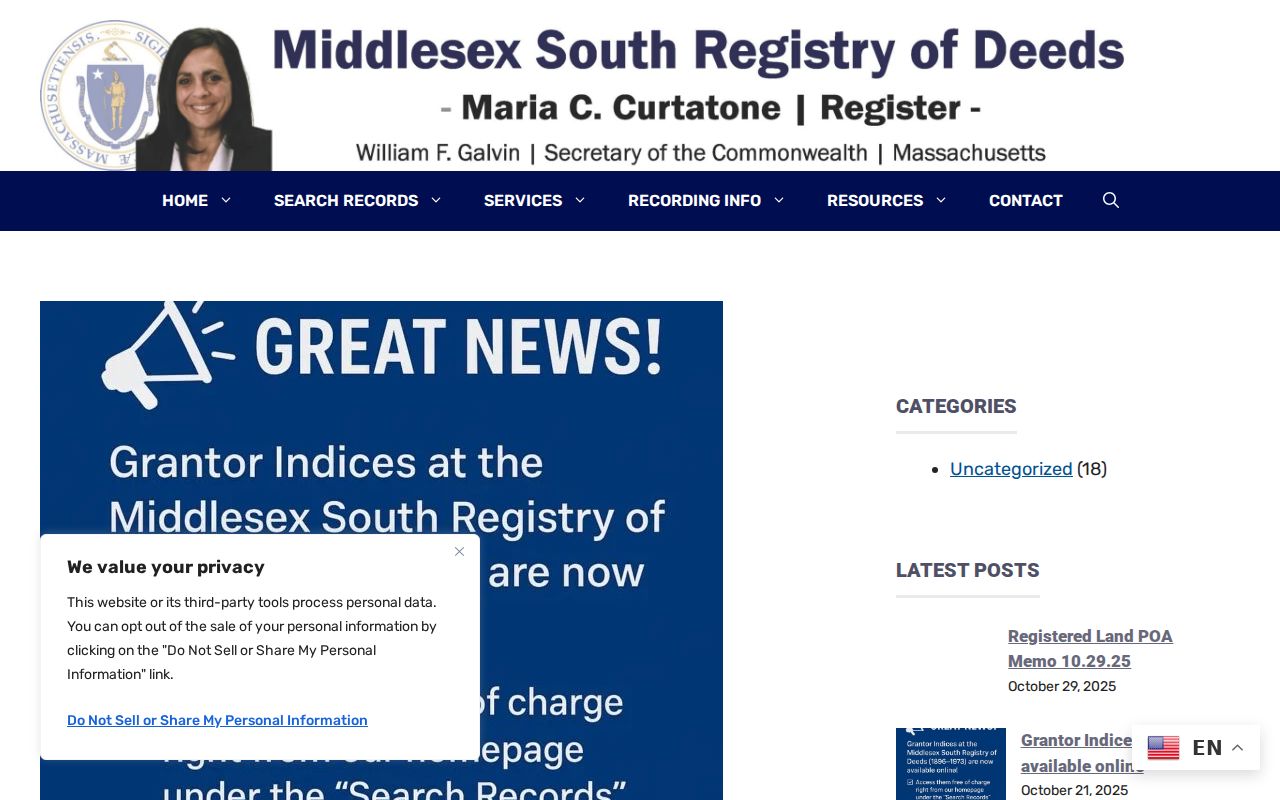
Use the scanned index as a record-finding aid, not as the final account of a property. Follow its book/page or party information into the document image, then compare the legal description with the current parcel.
Note: A deed-copy solicitation is not a Registry bill. The Registry warns that copies offered for high fees may be available free through MassLandRecords.
Woburn Address Change Trail
Address continuity is the hard part of tracking who lived here before. Official local sources warn that street names change over time, but no authoritative Woburn-wide renumbering table with dates was located. Do not assume that a nineteenth-century house number is the present parcel. Compare the directory address, Sanborn map label, historic city map, parcel map, plan, and deed legal description. A match across several dated sources is stronger than a familiar-looking number.
City boundaries also changed. Early Woburn territory included modern Wilmington, Burlington, and Winchester before those communities separated in 1730, 1799, and 1850. A family or property reference under older Woburn can therefore lead outside the present city. The Glennon Archives map holdings, including the 1831 plan, 1875 atlas, 1883 bird’s-eye view, 1889 and 1906 atlases, 1899 boundary atlas, and 1915 map with additions, are useful geographic bridges.
Woburn House History Clues
The Woburn Public Library offers a direct house-history route through the Glennon Archives. Its method begins with MACRIS and an architectural survey, then moves through the Southern Middlesex deed chain, permits, Water Department or Public Works clues, insurance information, Sanborn maps, directories and poll lists, and newspaper microfilm. The library can search poll lists and directories for names at an address, occupation, and possible owner or renter information. It also holds Sanborn maps from 1867 through 1971 in hard and digital forms.
The Woburn home-history guide shown here connects the paper trail to the library’s local research services.
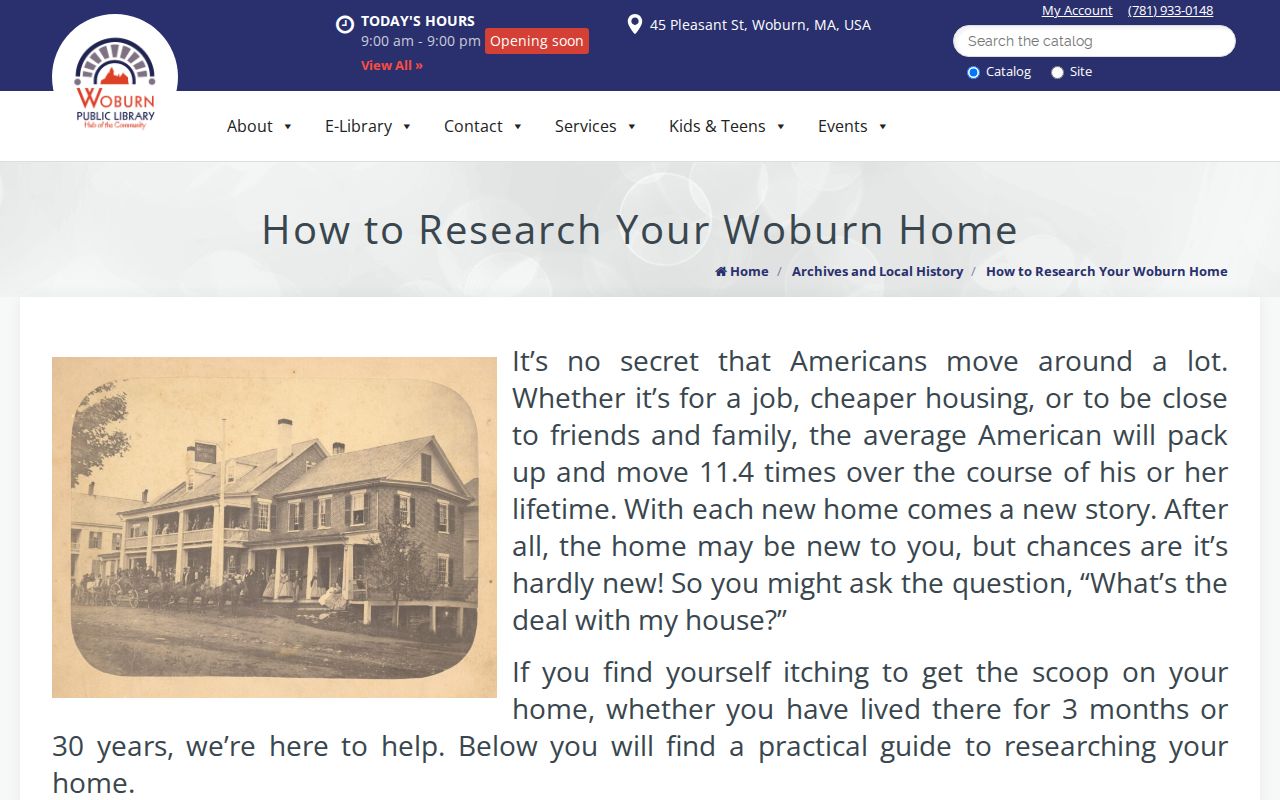
The guide matters when the deed chain alone leaves a gap. A permit can date work, a Sanborn sheet can show a building footprint, and a poll or directory can add a dated name without treating any one source as a complete household list.
Woburn Past Households
Ownership is only one layer of an address history. Woburn directories can be searched by dweller name, selected street-address sequences, or full yearly pages. The Historical Commission index lists runs in 1868, 1871, 1874, 1877, 1881, 1884, 1887, 1895, 1906, 1908, 1915, 1919, 1925, 1932, and 1937, but not every address sequence is complete. When the address path is missing, read the full scanned book and search surname variants. The archive collections are described in more depth on the Woburn city directory page.
- Record the exact street, number, spelling, occupation, and household notation from the first directory page.
- Check the next available directory run at the same address. If the address sequence is missing, use the dweller-name path and then read the street page.
- Pair that directory year with the nearest federal or state census. Census schedules identify households; directories are closer to annual snapshots.
- Check poll lists where available, preserving the list year and the difference between an address listing and voter registration.
- Search the Glennon newspaper index for a surname, address, “removed,” funeral, marriage, business, or organization reference, then retrieve the microfilm article.
Woburn Library has federal census microfilm for 1790 through 1920, with the national 1890 population-schedule loss in mind. Public federal schedules now reach 1950 under the 72-year rule. Use a directory and census together, but do not call a deed owner a resident or call a directory occupant an owner without the matching record.
Woburn Household Endpoints
The end of a Woburn household trail often appears in newspaper, cemetery, or probate material. Glennon newspaper indexes cover local titles from 1844 through 2014 with title-specific gaps. A search result supplies a subject, article description, and date; retrieve the microfilm article for context. Search not only “obituary,” but also surname variations, funeral, married, removed, residence, business, and organization terms. The library can scan and email articles from its reader.
For an estate, Middlesex Probate and Family Court South-Woburn can provide the official probate route, while the statewide case portal can be a docket starting point. Woburn Library identifies entries in the Middlesex County Probate Index for 1648 through 1909 at the Probate Registry and Massachusetts State Archives. An estate file may name an executor, heir, or final address, but sealed and impounded materials are not open research sources. Cemetery and Historical Society resources can help establish death and relationship context when a directory entry stops.
Woburn Previous Residents Limits
Past-household research is a house-history and family-history task, not a way to compile a live list of people. A parcel card may show a current owner, while a historical directory can omit boarders, children, women, or other household members. Utility customers and motor-vehicle addresses are not public address sources. Local voting lists are dated civic records and may omit protected voters. The Massachusetts Address Confidentiality Program and protected-voter rules can lawfully mask addresses.
When a city-held record is not online, a focused request under the Massachusetts Public Records Law, M.G.L. c. 66, § 10, can identify the address, record category, and date range. Woburn says requests do not need a prescribed form and generally receive a written response within 10 business days, subject to fees and lawful redactions.